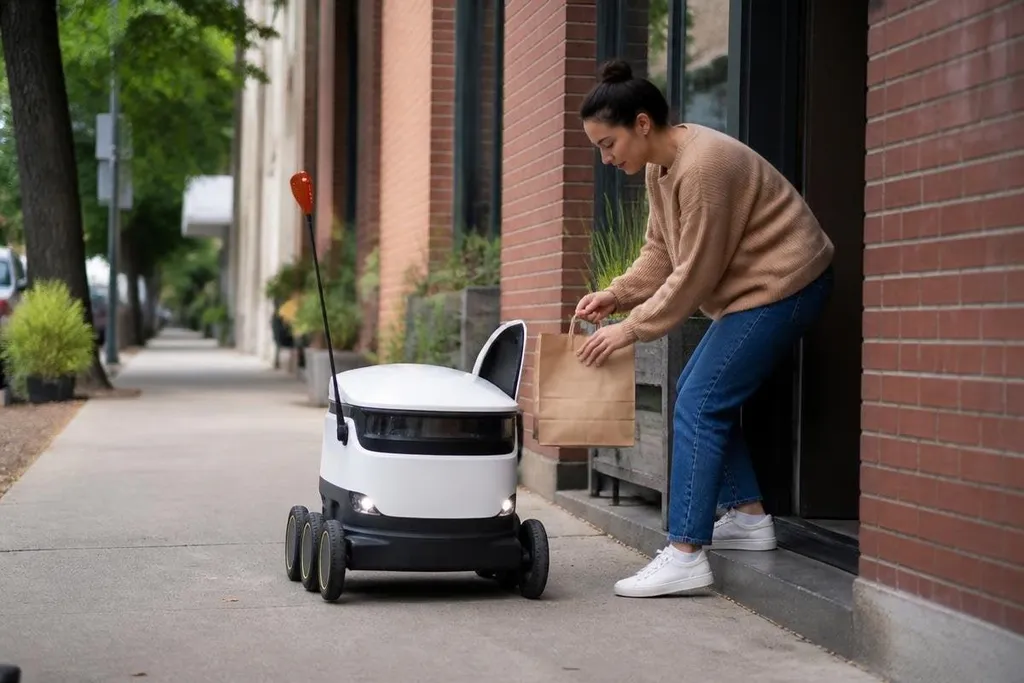
A sidewalk robot can carry a small load across a fixed route without a driver inside it. The business question comes first: who pays for that trip, and how often does the trip happen?
Quick read
- Delivery works best where trips repeat and loads stay small.
- Security, mapping, and advertising can add income, but each needs a clear buyer.
- A human fallback, charging plan, and local permission belong in the first budget.
Delivery is the clearest starting point
Local delivery gives sidewalk robots a simple job. A robot carries food, groceries, medicine, or parcels between a nearby store and customer, then returns to a depot or another pickup point.
The value comes from repeated short trips. A shop can avoid sending a staff member away from the counter, while the customer gets a delivery without a driver making a separate trip.
The robot's small size limits the work it can do, so this model fits light items and short routes.
That route needs more than a robot. It needs a loading area, a secure compartment, a way to confirm the handoff, and staff who can help when a gate or crowded path blocks progress. If the robot spends too much time waiting for people, the saving gets smaller.
A company could charge per trip, sell a monthly service to stores, or run a shared fleet for several shops. The right choice depends on who controls the route and who pays for staff, charging, repairs, and remote help.
Other buyers may pay for the same machine
Delivery is only one use. The same platform can carry cameras, sensors, or a small display, which opens other business models.
A property owner might pay for scheduled patrols around a site. A city or utility could use a robot to collect images of paths, signs, or surface damage. A retailer could rent the robot as a moving display near a store, provided local rules allow that use and people can pass safely.
These jobs have different buying tests. A patrol service needs a clear response when the robot spots a problem. Mapping work needs useful data in a known format. A display needs permission for its location and a reason for people to stop and look.
The same sidewalk robot can earn money in one contract and lose money in another, depending on the task and site. Robot 24 can help you compare the machine, route, buyer, and recorded result before you price the work. That keeps the plan tied to what the robot does outside a sales demo.
The hardware may stay similar, but the contract changes. That matters because a robot with no paying task is an expense with wheels.
The hard costs sit beside the robot
Its route must be readable to the sensors, and its wheels must handle the surface. The robot also needs safe behavior around people, bicycles, curbs, doors, and road crossings. Those conditions vary by place, so a route that works in one area may need more staff or different rules elsewhere.
Permission can shape the whole plan. Local authorities may set rules for sidewalk access, speed, parking, remote supervision, or data collection. A business also needs a response plan for blocked paths, damaged hardware, lost packages, and people who cannot complete a handoff.
Charging adds another fixed task. A fleet needs a place to charge, staff who can inspect the robots, and spare parts for normal wear. These are operating costs, not details to add after the sale.
The same point applies to remote support. If one operator watches several robots, the business must decide what happens when two units need help at once. The answer affects staffing and the number of routes one person can oversee.
A practical buying checklist
Use this before spending money on a pilot:
- Name the buyer: write down the person or organization that pays each month.
- Count the trips: record expected trips per day, load size, route length, and delivery windows.
- Check the route: inspect crossings, curbs, doors, slopes, surface quality, and busy periods.
- Price human help: include loading, remote support, customer handoff, cleaning, and repairs.
- Set failure rules: decide when staff take over and how customers receive refunds or replacements.
- Measure one result: choose a number such as cost per trip, completed handoffs, or staff hours saved.
I'd start with one short route and one paying customer, then expand only after the robot completes the agreed work without heavy human help.
The strongest sidewalk robot business will be the one with a repeatable route, a known buyer, and a cost per trip that still works after staff, charging, repairs, and local permission are included.